Irrigating blind is costly — in both directions
An irrigation round started too late means water stress just when the vines or the orchard cannot afford it: smaller fruit size, blocked ripening. A round started too early means water and pumping energy spent for nothing — and in a restriction zone, cubic metres that will be missing in August. Soil cannot be read by eye: between the surface, which dries out in two days, and the depth at 40 or 60 cm where the roots work, the gap is often several days of reserve.
A capacitive probe measures what the eye cannot see: the volumetric water percentage at root depth. The problem is that most offers on the market turn this measurement into an annuity: expensive hardware, then a compulsory annual subscription to keep seeing your own data. A capacitive probe with no subscription, bought once and working for as long as it measures, completely changes the calculation.
Market probes, honestly compared
| Solution | Purchase price | Subscription | Cost over 5 years |
|---|---|---|---|
| Capacitive probe with service (e.g. Agralis) | 1 200 to 1 500 € | ~90 €/year | 1 650 to 1 950 € |
| Connected tensiometer/capacitive probe (e.g. Weenat) | 850 to 1 190 € | ~144 €/year | 1 570 to 1 910 € |
| FURGO single-depth probe | 423,50 € | 0 € | 423,50 € (+ SIM top-up ~30 € around year 4) |
| FURGO 40 cm two-depth probe | 713,90 € | 0 € | 713,90 € (+ SIM top-up ~30 € around year 4) |
Competitor prices are those publicly listed in early 2026 — check them, they change. What this table does not show: with a subscription, stopping the payments means losing access to your measurements. Once bought, a FURGO probe keeps transmitting for as long as it works, and your data remains yours.
What the FURGO probe actually does
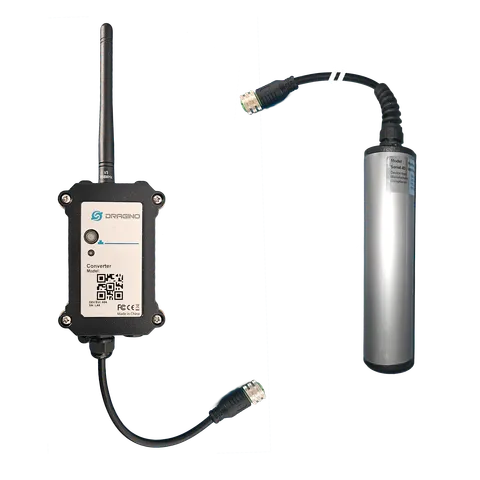
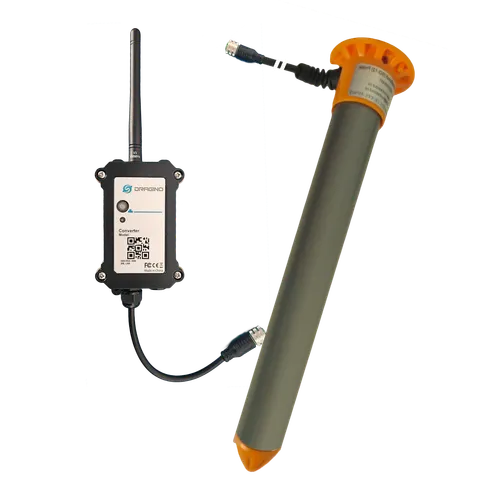
- It measures the volumetric soil moisture with an HSTI capacitive sensor, pre-calibrated for 3 soil types: you select your texture on the interface, that is all.
- It transmits 8 times a day to the Supervisor platform, included. No gateway, no box: the SIM card sits inside the housing and works wherever there is GSM coverage, on any network.
- It calls you when your threshold is crossed. A voice call to up to 10 numbers — not a lost notification. SMS and emails as back-up.
- It runs autonomously for 3 to 5 years: long-life battery (~7 000 transmissions) and pre-loaded SIM plan (350 Mo, 60 calls and SMS). One top-up when it falls due, and off it goes again.
- It is IP66 waterproof and arrives configured: bury it at root depth, switch it on, receive the data.
One, two or more depths: choose according to your roots
The right probe depends on the rooting depth of your crop, not on the catalogue:
- Market gardening, young plantings, shallow soils: the single-depth probe at 423,50 € excl. VAT is enough to track the main root zone.
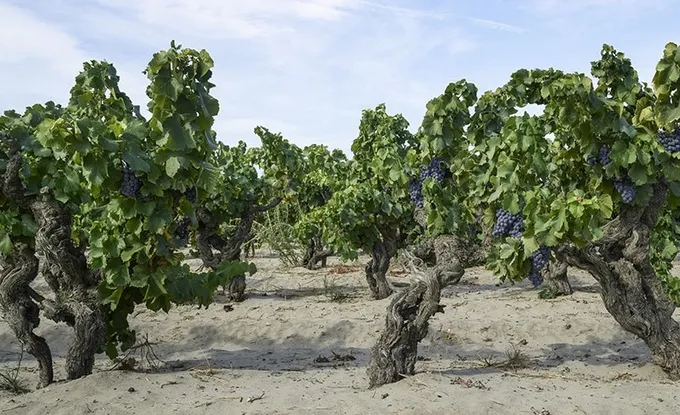
- Vineyards and orchards on medium soil: the multi-depth probe (713,90 € excl. VAT in the 40 cm two-depth version) distinguishes the surface layer, which reacts quickly, from the reserve layer — it is the gap between the two that tells you whether a short or a long irrigation round is needed.
- Fruit growing, deep-rooted vines: the 60 cm multi-depth probe (810,70 € excl. VAT) goes down to where the late-summer reserve is decided. Three-depth (871,20 €) and four-depth (993,40 €) versions exist to profile the whole soil — contact us for those configurations.
At these prices, equipping two plots with different soils costs less than a single competitor probe with its subscription — and managing by soil type beats a single extrapolated measurement.
In practice: managing irrigation rounds
The principle is the same in winegrowing, fruit growing or market gardening: you set a low threshold (irrigation start) and, if useful, a high threshold (stop, to avoid leaching). In between, you look at nothing — the probe calls you. On the platform curve, you also see whether the water applied actually reaches the deep layer or stays near the surface: that is often the first surprise, and it changes the length of irrigation rounds from the very first season.
Where to start
- Identify the rooting depth of your crop (a quick auger hole is enough).
- Choose the matching probe: single depth for shallow soils, 40 or 60 cm with two depths beyond that.
- Bury it in the row, as close as possible to a representative dripper, switch it on, set your thresholds on the platform.
The probe arrives configured, delivered within 2 weeks. Unusual soil, large areas, need for 3 or 4 depths? Describe your situation — we reply with a priced proposal, not a sales appointment.