One undetected frost night can cost the harvest
In April 2021, frost hit nearly 80 % of French vineyards in two nights. At the scale of a single farm, the maths is simple: in an apricot orchard in full production, one night at -2 °C at the wrong growth stage can destroy several thousand euros of harvest per hectare. The means of protection exist — sprinkler protection, wind machines, frost candles — but they are useless if triggered too late, and expensive when triggered for nothing.
So the problem is not knowing that cold is coming (the forecast tells you that), but knowing when, on your plot, the temperature of the plant tissue is approaching the critical threshold. That can come down to a single hour and a single degree — in the middle of the night. This is exactly the job of an orchard and vineyard frost alarm worthy of the name: measure in the right place, and warn you at the right moment.
Market solutions, honestly compared
| Solution | Purchase price | Subscription | Cost over 5 years |
|---|---|---|---|
| Min-max thermometer + alarm clock every 2 h | ~20 € | — | 20 € and exhausting seasons |
| Connected weather station with frost module (e.g. Sencrop, Weenat) | 400 to 700 € | 100 to 250 €/year | 900 to 1 950 € |
| Frost alarm unit (e.g. Agriscope) | 270 to 320 € | ~60 €/year | 570 to 620 € |
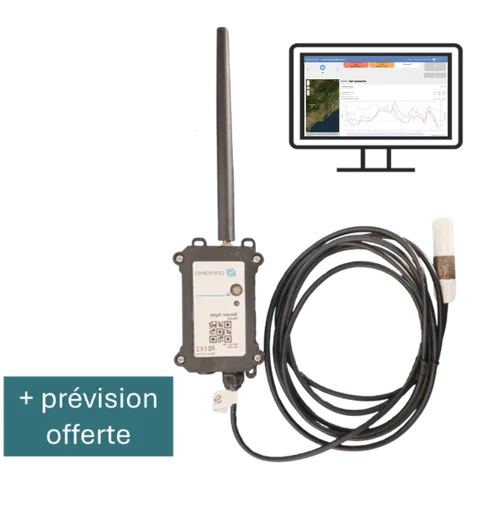
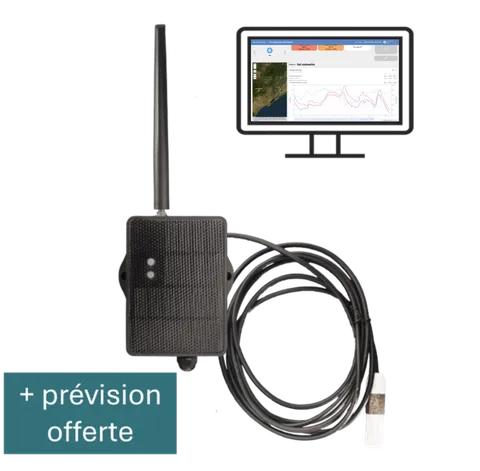
| FURGO S31-NB Frost Alarm sensor | 195 € | 0 € | 195 € (+ SIM top-up ~30 € around year 4) |
Competitor prices are those publicly listed in early 2026 — check them, they change. What this table does not say: most subscription offers cut off the alerts if you stop paying. Once bought, a FURGO sensor keeps alerting for as long as it works.
What the FURGO sensor actually does
- It measures the dry temperature and calculates the wet-bulb temperature — the one that matters in radiative frost, because it anticipates the real cooling of the bud by 2 to 3 °C.
- It calls you. Not a notification lost in a phone on night mode: a voice call, to up to 10 numbers in cascade — you, your employee, the neighbour who shares the wind machine. SMS and emails as back-up.
- It runs autonomously for 3 to 5 years, SIM card included, with no gateway or box: strap it to a post, switch it on, done.
- At 195 € excl. VAT per unit, you can place several: one per frost-prone block rather than one expensive station in the middle of the farm. Frost is a matter of microclimate — two plots 500 m apart can differ by 2 °C.
In practice, among those who use it
From fruit farms in the Drôme to the experimental plots of technical institutes in the south of France, the scenario is the same: threshold set on the wet-bulb temperature at the start of the season, sensors placed on the low spots, and nights of sleep recovered between two frost events. Settings are adjusted from the Supervisor platform, included in the price.
Where to start
- Identify your frost-prone areas (low spots, valley bottoms, hedge borders).
- Allow one sensor per homogeneous area — most farms start with 1 to 3.
- Add a weather forecast point to anticipate risky nights 48 h ahead (2 points included with each sensor).
The sensor arrives configured. If your situation is out of the ordinary (large areas, grower groups, coupling with sprinkler protection), describe it to us — we reply with a priced proposal, not a sales appointment.